
Videos of Conference presentations
January 20, 2026 MPC Videos, Chat and Attendees
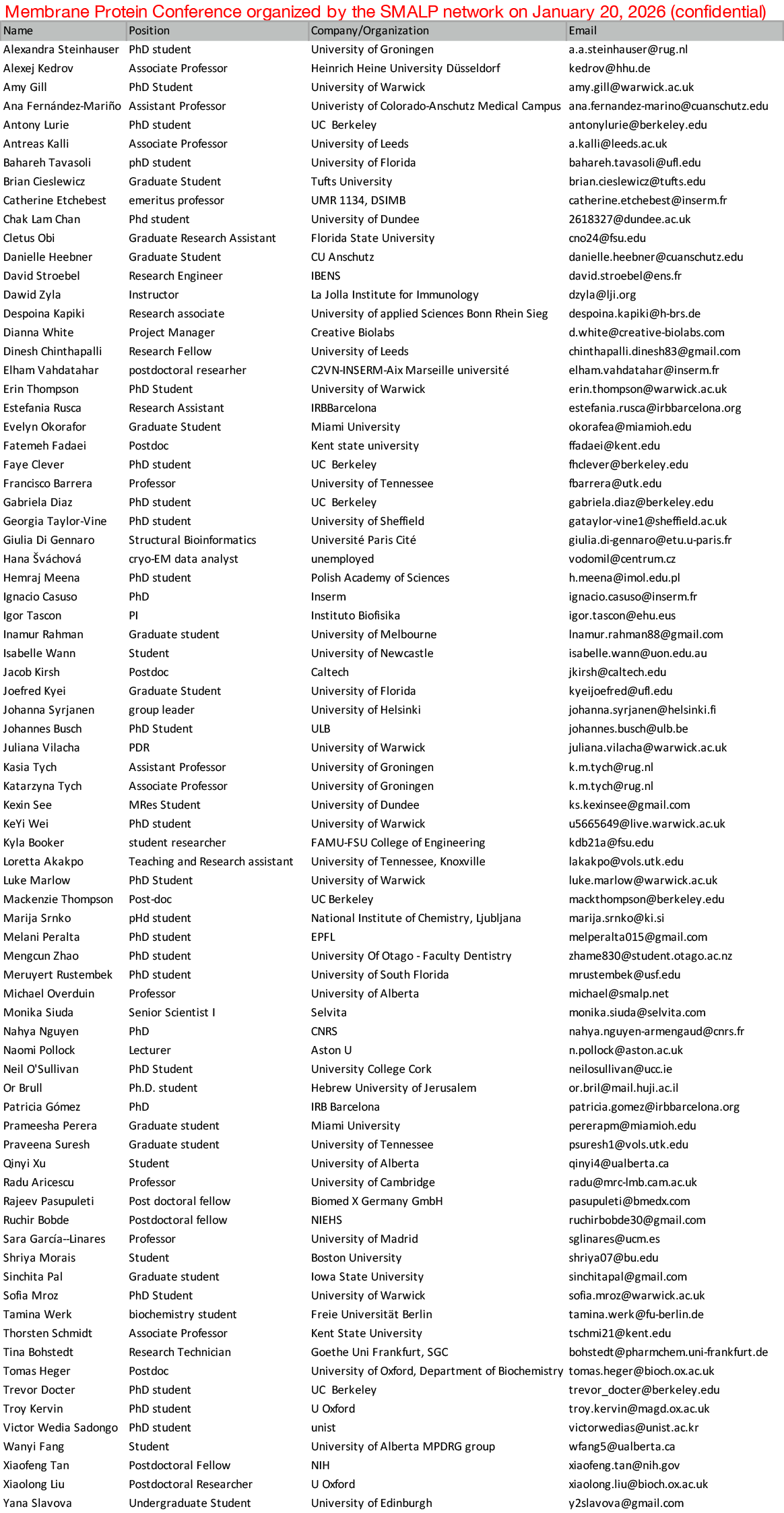
 Troy Kervin, PhD Student, U Oxford will present Factory Reset: How to Uninstall Lipid Raft Bloatware and Migrate to the Proteolipid Code and Sheaf-theoretic representation of the proteolipid code.
 Xiaolong Liu, Postdoctoral Researcher, U Oxford, on a new paradigm for outer membrane protein biogenesis in the Bacteroidota.
 Sara García-Linares, Professor, Complutense, U Madrid, on elucidating the structure and assembly mechanism of actinoporin pores in complex membrane environments.
 Antreas Kalli, Associate Professor, Discovery and Translational Science Department, U Leeds, on regulation of PIEZO1 channel force sensitivity by interblade handshaking.
 Ana Fernandez-Marino, Assistant Professor, UCD Anschutz Medical Campus on the structural basis of fast N-type inactivation in Kv channels.
 Dawid Zyla, Postdoctoral Researcher, La Jolla Institute for Immunology, on Stabilized Full-Length Measles Fusion Protein Elicits Potent Immunity and Protection In Vivo.
 Mackenzie Thompson, Postdoctoral Researcher, Dept of Molecular & Cell Biology, UC Berkeley, on Asynchronous subunit transitions prime acetylcholine receptor activation.
Chat Space on January 20, 2026
00:59:39 Michael Overduin: Any questions for Troy?
01:12:09 Troy Kervin: Kervin, T. A. Factory Reset: How to Uninstall Lipid Raft Bloatware and Migrate to the Proteolipid Code. Zenodo (2026). https://doi.org/10.5281/zenodo.18225636
01:12:31 Elham VAHDATAHAR: Reacted to "Kervin, T. A. Factor..." with 👍
01:12:37 Naomi Pollock: Reacted to "Kervin, T. A. Factor..." with 👍
01:13:36 Michael Overduin: Any questions for Xiaolong?
01:28:34 Michael Overduin: Do your BAM assemblies operate singly, surrounded by lipid, or do they organize into islands that function cooperatively?
01:36:55 Sinchita Pal: How you confirm the complex is purified?
01:39:59 Michael Overduin: Any questions for Sara?
01:48:36 Xiaolong Liu: Replying to "How you confirm the ..."
we have tagged the protein BamA, and purified the complex after solubilizing the outer membrane. We confirmed afterward by checking with gels and blotting, as well as mass-spec detection and so on.
01:49:03 Michael Overduin: How much evidence is there for conformational changes in monomer during pore assembly?
01:53:30 Thorsten Schmidt: How large can plastic particles be to be still be degraded?
01:55:46 Michael Overduin: Can the 30 nm pores be solubilized in nanodiscs for structural analysis? If so which nanodiscs are recommended for this?
02:00:25 Dinesh Chinthapalli: Can you isolate both monomers and Octamers?
02:00:41 Dinesh Chinthapalli: independently
02:04:19 Sara Garcia-Linares: Replying to "Can you isolate both..."
We could not see monomers in membranes. Binding is really efficient, so the least numbers of bound monomers we saw was 4. But we are working on getting archs with different stoichiometries
02:06:20 Dinesh Chinthapalli: Replying to "Can you isolate both..."
Intriguing
02:06:50 Michael Overduin: Please ask Antreas questions here.
02:18:23 Troy Kervin: that's really cool
02:19:40 Michael Overduin: How do the trimers assemble? Do they preform outside the membrane? Are specific lipids required for assembly?
02:21:17 Michael Overduin: Footprints sounds more forceful than fingerprints in terms of impact on lipid organization. Do you feel that one term is more useful?
02:21:18 fatemeh fadaei: Hello, Which force field did you use?
02:21:22 DAVID STROEBEL: What’s the mechanism behind the effect of cholesterol ? Is it linked to compaction or change of curvature ( or both)?
02:23:34 fatemeh fadaei: thanks
02:23:43 DAVID STROEBEL: Thanks!
02:25:26 Troy Kervin: footprint = big fingerprint
02:25:34 Troy Kervin: ?
02:27:11 Michael Overduin: The next MPC will be on May 12, the popular choice.
02:29:23 Michael Overduin: Feel free to ask Ana and Xiaofeng questions here.
02:43:27 Michael Overduin: Is acetylation of the N-terminus regulated?
02:52:25 Naomi Pollock: Really sorry, but I have to leave a little early today. The conference and training event I mentioned are here. Please consider attending, or encourage your trainees to attend. Membrane Proteins Conference 2026; 7th UK Workshop on Membrane Proteins Thanks to Michael and all the speakers for a great afternoon of talks.
02:52:48 Dinesh Chinthapalli: Ana, that's a great talk. Is there a way to stop acetylation of Alanine via mutation and check the mechanisms?
02:53:39 Michael Overduin: Feel free to mention if you are recruiting student/postdocs/etc. There are lots of great candidates here.
03:06:56 Michael Overduin: Feel free to ask Dawid questions here.
03:07:38 Michael Overduin: Does the intact trimeric transmembrane helix fold require bound lipids?
03:08:59 Michael Overduin: If so can these lipids be preserved or added back to stabilize the full trimer structure?
03:14:54 Michael Overduin: Please ask Mackenzie questions here.
03:30:14 Michael Overduin: Are lipids like PIP2 involved in the allosteric ligand binding and gating mechanism?
03:37:53 Evelyn Okorafor: Thank you
03:38:01 Sara Garcia-Linares: Thank you!
03:38:04 Inamur Rahman: Thank you
03:38:05 Troy Kervin: bye!
03:38:11 Antreas Kalli: thank you very much.
03:38:13 Rajeev Pasupuleti: Thank you!
03:38:15 Erin Thompson: Thank you
03:38:16 Catherine Etchebest: Thank you very much to all the speakers.
03:38:22 Igor Tascon: Thank you!!
03:38:45 DAVID STROEBEL: Thanks a lot!
03:39:09 Trevor Docter: Thanks!
Sept 17, 2025 MPC Videos, Chat and Attendees

 Philipp Hanisch, Head of Laboratory - Protein Service, Cube Biotech GmbH will discuss his recent bioRxiv paper Membrane Proteins at Scale: Automated Copolymer Nanodisc Purification for Structure and Function
 Jasmin Baron, PhD Student in Medical Physics and Biophysics, University of Graz, who recently published Utilizing native nanodiscs to isolate active TRPC3 channels and expand structural analysis capabilities in Sci Rep.
 Anastasiia Sukalskaia, Postdoctoral Researcher with Raimund Dutzler, U Zurich, who recently published on the interactions between TTYH2 and APOE facilitate endosomal lipid transfer in Nature.
 Lucie Bergdoll, Researcher, LISM, CNRS, Aix-Marseille Université recently published membrane lipid composition modulates the organization of VDAC1, a mitochondrial gatekeeper in Commun. Biol.
 Francesca Marassi, Professor Dept Biophysics, Medical College of Wisconsin who recently published in situ NMR reveals a pH sensor motif in an outer membrane protein that drives bacterial vesicle production in PNAS USA.
 Joseph Iovine, PhD student with Nathan Alder, Dept of Molecular & Cell Biology, U Connecticut, on lateral lipid packing governs bilayer solubilization by styrene-maleic acid copolymers: a case study with cardiolipin-containing membranes.
 Richard Hite, PI, Sloan Kettering Institute, who recently published Structural basis of ClC-3 transporter inhibition by TMEM9 and PtdIns(3,5)P2 in Nat Struct Mol Biol.
 Alyssa Ward, PhD Student with F. Barrera, Dept of Biochemistry & Cellular and Molecular Biology, U Tennessee Knoxville recently posted cholesterol promotes the formation of dimers and oligomers of the receptor tyrosine kinase ROR1.
 Beining Jin, PhD Student with Matthew Eddy, University of Florida, who recently published the Conformational Equilibria of a Human GPCR Compared between Lipid Vesicles and Aqueous Solutions by Integrative 19F-NMR in JACS.
Chat Space on Sept 17, 2025
00:28:21 Gestél Kuyler: Feel free to ask Philipp any questions in the chat.
00:38:59 suraj patil: Thats a really really great work, i wanted to ask if you have tried these copolymers for SLC25 family?
00:45:03 Michael Overduin: Did you resolve any native lipids in the structures?
00:45:30 suraj patil: Thank you, did you also any structural differences with diff polymers?
00:46:32 David Wright: It's great that you've managed to screen over thirty co-polymers per target. Have you been able to put together a smaller diverse list for those who don't have a robotic set up?
00:46:34 Antony Yerabham: Is there a property of the Copolymer that would determine the final size of the nanodisc formed.?
00:49:15 victor sadongo: maybe I missed it, are the lipids in the nanodiscs cell extracts or synthetic lipids
00:50:03 Antony Yerabham: Replying to "It's great that you'..."
Please refer to https://cube-biotech.com/solubilization-database
00:50:34 Dinesh Chinthapalli: Have you seen any higher order Oligomers of any of the studied proteins?
00:51:06 Gestél Kuyler: Feel free to ask Jasmin any questions in the chat
00:51:07 Mengcun Zhao: Reacted to "Please refer to http..." with 👍
00:52:44 Philipp Hanisch: Replying to "Thats a really reall..."
Hey thank you for your question. I have checked and so far we have data for SLC25A4 and A15. In total we have successful data for 13 different SLCs.
00:53:39 suraj patil: Replying to "Thats a really reall..."
thank you:)
00:53:53 Michael Overduin: Feel free to share information/links about job opportunities, open access facilities, meetings, conferences, etc.
00:54:12 Philipp Hanisch: Replying to "Thank you, did you a..."
We did not get differences in structure but we saw huge differences in orientation on the grid. Some copolymers gave us huge issues. For P2X4 it was straighforward only with Cubipol variants.
00:54:56 Philipp Hanisch: Replying to "maybe I missed it, a..."
they are directly solubilized with the membrane protein from the native lipid environment/ cell membrane. So no addition whatsoever
00:55:43 victor sadongo: Reacted to "they are directly so..." with 👍
00:56:39 Philipp Hanisch: Reacted to "thank you:)" with 👍
00:57:02 Philipp Hanisch: Replying to "It's great that you'..."
If you want to cut down I advice you to use the next gen copolymer backbones AASTY, Ultrasolute Amphipol and Cubipol. Our study shows that those outperform DIBMA and SMA.
00:58:13 Philipp Hanisch: Replying to "Have you seen any hi..."
yes we very frequently see something like higher oligomers in SEC. if this is nanodiscs sticking together, multiple MPs in one disc or a real higher oligomeric structure has to be checked for each target.
00:59:30 suraj patil: Replying to "Thank you, did you a..."
thanks 🙂
01:00:23 Chellam Gayathri Subash: Replying to "Feel free to share i..."
Hi Chellam here, from Maxion Therapeutics, UK. We are looking for a protein scientist to join our team. If interested, please reach out to cgs@maxion.co.uk. Thanks
01:00:41 Dinesh Chinthapalli: Replying to "Have you seen any hi..."
Thank you for your information; Have seen these any of them in Cryo-EM besides reported Oligomers
01:01:11 Philipp Hanisch: Replying to "Have you seen any hi..."
can you specify? I am not sure I understand
01:02:15 Nora Migdad: Do you think that the difference in extraction efficiency with different detergents/polymers is due to the cell types themselves or rather how the protein is produced within these cell lines?
01:05:30 Michael Overduin: Is DDDG available for researcher to try / buy?
01:07:56 Felipe Merino: Replying to "Did you resolve any ..."
Hi Michael. The Lipids issue in Cryo structures is always hard because they are usually not very well defined. In the P2X4 structures there are some additional densities in the nanodisc area, but nothing "clear cut" enough to assign them to specific lipids. We decided to not include that in the paper.
Interestingly, if you look at the strucutres of other MPs in copolymers, less than half will actually have clear lipid densities, even though lipids are clearly there.
01:10:58 Gestél Kuyler: Feel free to ask Anastasiia questions in the chat
01:14:18 Jasmin Baron: Replying to "Is DDDG available fo..."
Yes, I think so. We got it from our collaboration partner Sandro Keller, who is in close collaboration with Gregory Durand. You can find more information here: DOI: 10.1002/smll.202103603. And for more information you can contact Sandro or Gregory directly:)
01:29:33 Michael Overduin: How much lipid specificity does the exchange reaction display?
01:30:01 victor sadongo: I just wonder if ApoE binds, does it affect the TTYH2 dimeric interfaces (monomer-dimer equilibrium).
01:30:58 Michael Overduin: Does the predicted structure of the C-terminal domain match the density?
01:35:03 Tomas Heger: Amazing talk @Anastasiia Sukalskaia. Were there any major hurdles in the native vesicle prep workflow?
01:35:03 Kyungsoo Shin: Do you know if there is a difference in binding to TTYH2 when using a spherical ApoE lipid complex (i.e., with cholesterol esters)?
01:35:36 Anastasiia Sukalskaia: Replying to "How much lipid speci..."
we think it's pretty promiscuous, all lipids should be able to go
01:36:51 Anastasiia Sukalskaia: Replying to "Does the predicted s..."
AF predicts the C-terminus of ApoE to fold in a single alpha helix, which we know is not correct from the NMR structure. It seems like this domain is very flexible and can adapt multiple conformations
01:38:21 Anastasiia Sukalskaia: Replying to "Amazing talk @Anasta..."
Thank you! The vesicle prep was actually quite straightforward, however we couldn't push the structure to a higher resolution, likely because the protein is a bit too small
01:38:32 Michael Overduin: Feel free to ask Lucie questions here
01:39:11 Anastasiia Sukalskaia: Replying to "Do you know if there..."
That's a good question! We have not tried the speherical particles, but would be really cool to see if there would be any difference!
01:39:23 Tomas Heger: Replying to "Amazing talk @Anasta..."
A follow-up if you allow: so it was mostly ok for you to just follow the method paper without to much optimization/changes? Thank you very much!
01:50:40 Michael Overduin: Might other mitochondrial lipids like cardiolipin also bind tightly to VDAC conformers?
01:53:02 victor sadongo: am just curious did you consider cardiolipin as its composition is higher in mitochondrial membranes compared to other organelles
01:54:14 francesca marassi: I am curious how did you determine the lipid type preference around the protein?
01:58:26 Anna Pugnetti: Replying to "Amazing talk @Anasta..."
@Tomas Heger Hi Tomas, I worked with Anastasiia and there were some minor changes, the details are in the methods of Anastasiia's recent paper
01:59:04 Tomas Heger: Replying to "Amazing talk @Anasta..."
Thank you very much for the reply.
02:00:02 Beining Jin: @Lucie Bergdoll Really great talk! Have you looked into the orientation of VDAC under different lipid compositions?
02:01:52 Lucie Bergdoll: Thanks, under the different compositions we used it was parallel. But if you use only DMPC, it will form antiparallel dimers (ujwal et al. 2008). We discuss it in our paper, it is probably due to the asymmetry of the lipids which compensate the asymmetry of the proteins and allow for parallel organization.
02:02:13 Lucie Bergdoll: asymmetry of the lipid binding to VDAC
02:03:14 Beining Jin: Replying to "asymmetry of the lip..."
Good to learn, thank you
02:06:54 Michael Overduin: Were any tricks required to obtain resolved HSQCs of Ail in nanodiscs? E.g. temperature, lipid type, buffer, etc?
02:18:53 francesca marassi: "Tricks" were temperature, deuteration and fine control of protein concentration.
02:26:19 Michael Overduin: In the break I will ask for votes for the next MPC date of either January 12, 20 or 23 (2026) in a zoom poll.
02:33:28 Michael Overduin: Do you think addition of DMPC would also reverse TOCL inhibition (as this is less denaturing and widely used)?
02:39:42 Michael Overduin: Feel free to ask Richard questions here
02:48:24 Michael Overduin: Do other lipids such as cholesterol mediate subunit contacts in the CIC3:T9A assembly?
02:50:51 Michael Overduin: Does the regulated C-terminus associate with membrane lipids when dissociated from the pore?
02:57:13 Michael Overduin: Please ask Alyssa questions here
03:06:07 Michael Overduin: Do lipids modulate ROR1 or ROR1/2 catalytic activity?
03:07:48 Barry Bruce: Did you test the GUVs at the physiological temp of 37°C?
03:13:38 francesca marassi: Thanks very much for inviting me to participate in this really great meeting. Keep in touch. All best - Francesca
03:22:02 Krish Patel (Anatrace): Thanks Michael for the invitation to the conference today. I have another meeting to go to.
Adding a note here for other participants on our new product launch, MG-C11, a Melamine Cored Glucoside. Please find below the link to the product details.
https://anatrace.com/en/category/mg-c11-Di-Undecyl-Melamine-Cored-Glucoside
Thanks again- Krish.
03:24:29 Michael Overduin: Please ask Beining questions here.
03:32:02 David Wright: Sorry if I missed it, but did you need to mutate out native cys residues?
03:35:58 Bert Klumperman: Michael, what is the outcome of the poll for the Stellenbosch meeting?
03:36:30 Michael Overduin: Please fill out the feedback form at https://docs.google.com/forms/d/e/1FAIpQLScwTf-JcoImSCykqDOlJdFCFNi3EXf_8V-px0W84iqczc3R_A/viewform
03:37:22 Bert Klumperman: Thanks!
03:37:53 Pravin Mahajan: Thank you.
03:37:59 Joseph Iovine: Thank you so much!
03:38:01 Alyssa Ward: Thank you!
03:38:03 Beining Jin: Thank you!
03:38:07 Tina Bohstedt: Thanks a lot!
June 24, 2025 Videos and Attendees
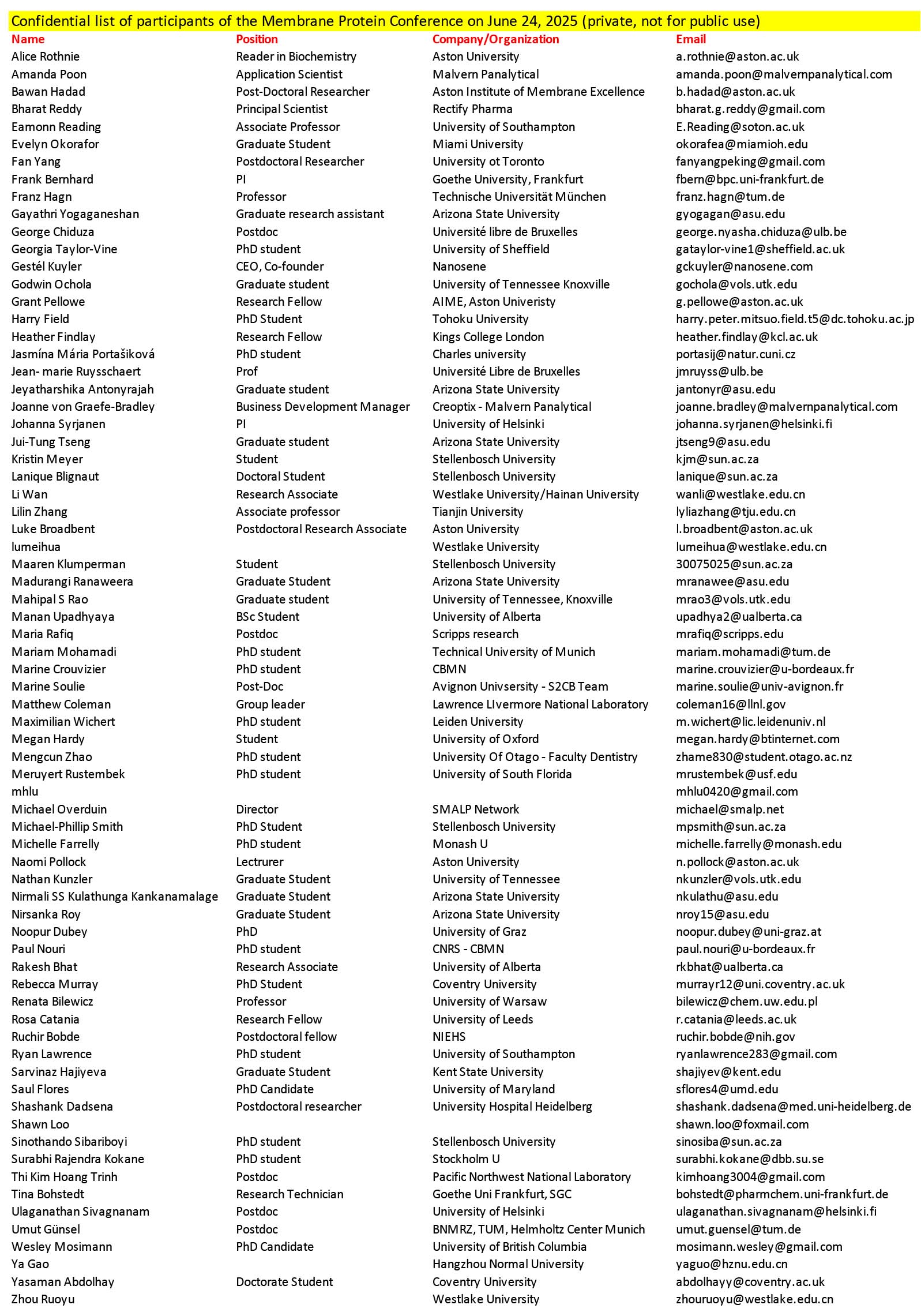
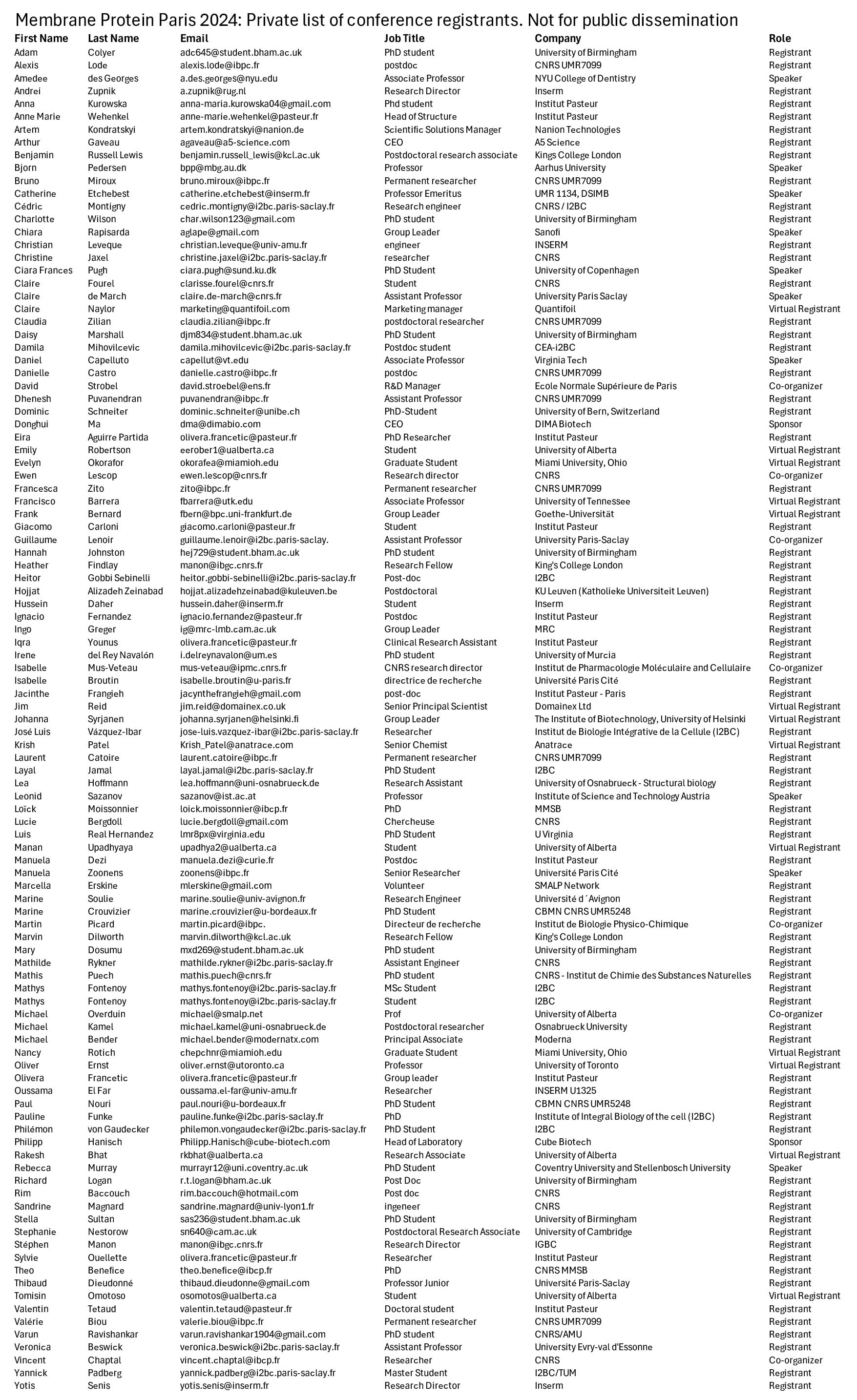
 Michelle Farrelly, PhD from Monash U (Chemistry) on tethering RAFT-synthesised SMA polymers on gold surfaces in ChemPlusChem.
 Rosa Catania, Research Fellow, Membrane Protein Biotechnology, U Leeds on solid-supported polymer–lipid hybrid membrane for bioelectrochemistry of a membrane redox enzyme in RSC Appl Interfaces.
 Michael-Phillip Smith, PhD student with Bert Klumperman, Department of Chemistry and Polymer Science, Stellenbosch U on RAFT-mediated synthesis of SMA 2:1.
 Li Wan, Research Associate, School of Life Science, Westlake U, on the structure and assembly of the dystrophin glycoprotein complex in Nature.
 Surabhi Kokane, PhD student, Stockholm U, on PIP2-mediated oligomerization of the endosomal sodium/proton exchanger NHE9 in Nature Commun.
 Umut Günsel, Postdoctoral Researcher, Helmholtz Center Munich, on the structural basis of apoptosis induction by the mitochondrial voltage dependent anion channel on bioRxiv.
 Eamonn Reading, Associate Professor, University of Southampton on the molecular basis for multidrug efflux by the anaerobic RND transporter MdtF.
 Frank Bernhard, PI, Goethe U Frankfurt on Cell-free expression platform for generating membrane protein/nanoparticle structures; recently published Cryo-EM structure of a cell-free synthesized full-length human β1-adrenergic receptor in complex with Gs on bioRxiv
 Michael Overduin, Professor, U Alberta on the language of lipids and proteins and improved SMA derivatives for native nanodiscs
Chat from Membrane Protein Conference on June 24, 2025
00:54:30 Michael Overduin: Feel free to ask Michelle questions here
01:08:37 Michael Overduin: Michelle: How do your S:MA (1.7:1) derivatives perform in terms of biological membrane solubilization? What is the off-rate from the surface - would this allow screening of small molecules to TM proteins in the immobilized SMALP? Will your best polymers be available commercially?
01:11:56 George Chiduza: Do you think the topology of the surface would make a difference?
01:15:02 Michael Overduin: Feel free to ask Rosa questions here
01:15:24 Michelle Farrelly: Hi Michael,
01:19:49 Michelle Farrelly: The offrate from the surface was not measured in this case although this is possible with QCM-D. QCM-D is similar to SPR in having an ability to measure the pharmacological characteristics (binding constants, add rate etc) of ligands interacting with MPs. This would indeed be a great way to use this method.
01:21:06 jean marie ruysschaert: Hi
01:21:19 jean marie ruysschaert: Hi
01:23:14 Michelle Farrelly: The diblock SMA copolymers will not be available commercially but the method is available to polymers made using RAFT polymerisation
01:26:52 Maximilian Wichert: For Rosa: Do you think this immobilization technique would also work while keeping the HVs intact?
01:26:56 jean marie ruysschaert: How do you control the orientation of the protein in the bilayer?
01:31:29 Michael Overduin: Rosa: are there any tricks to releasing a protein from a SMALP to insert into and orient correctly in a vesicle?
01:36:52 Michael Overduin: Feel free to ask Michael questions here
01:44:12 Michael Overduin: Michael: would your method make it easier to add a substituent to the SMA backbone, e.g. a methyl or halogen group?
01:49:14 Michael Overduin: Michael: are the 1H and 13C NMR peaks much sharper for your new polymers in line with their narrower dispersity?
01:59:05 Michael Overduin: Feel free to ask Li Wan questions here
02:09:21 Michael Overduin: Where there any tricks to solubilizing the complex intact from muscle for resolution by cryoEM?
02:09:51 Michael Overduin: Are the bound lipids identified?
02:10:33 Michael Overduin: Are any PTMs evident in the structures?
02:16:57 jean marie ruysschaert: Same question as michael: any bound lipid required for activity?
02:19:43 Michael Overduin: Please ask Surabhi questions here
02:20:12 Li Wan: Replying to "Are the bound lipids..."
Yeah, there are many lipids bound to the DGC,as well as some sugars
02:21:22 Li Wan: Replying to "Are any PTMs evident..."
there should be phosphorylations, but the resolution of that part is too low to see the density of phosphorylations
02:22:31 Johanna Syrjänen: Replying to "Same question as mic..."
Related to this question @Li Wan - can any disease mutations be mapped to amino acids that interact with the bound lipids?
02:24:33 Li Wan: Replying to "Same question as mic..."
some lipids mediate the interactions of the proteins within DGC, we think they will have some effects on the activity of DGC.
02:28:41 Li Wan: Replying to "Same question as mic..."
@Johanna Syrjänen we did not observe this kinds of mutations that interact with the bound lipids.
02:29:45 jean marie ruysschaert: Hi,
02:30:51 Michael Overduin: Does bound PI(3,5)P2 specifically activate and sort NHE9 to late endosomes compared with PI(4,5)P2, for example?
02:32:37 jean marie ruysschaert: Even POPC seems to stabilize the dimers!PIP2 specificity?
02:35:25 George Chiduza: Is NHE9 typically enriched at sites of endocytosis? Why does it go the plasma membrane at all?
02:35:48 Umut Günsel: Have you tried getting a cryoEM structure in the presence of this 3,5 lipids?
02:39:33 Michael Overduin: Feel free to ask Umut questions here
02:51:31 Michael Overduin: Does the exposed N-terminal helix engage lipids peripherally?
02:51:53 Michael Overduin: If so, which lipids are specifically bound?
02:53:26 George Chiduza: There is evidence showing the VDAC1 dimmer has lipid scramblase activity, how do you think this fits in with your model?
02:53:57 shashank Dadsena: Reacted to "There is evidence sh..." with 👍
02:56:28 jean marie ruysschaert: Reacted to "There is evidence sh..." with 👍
03:03:11 Surabhi Kokane: Replying to "Does bound PI(3,5)P2..."
Yes PI(3,5)P2 specifically activate. The sorting is based on internal pH and that is regulated by V-type ATPase
03:03:40 Umut Günsel: Replying to "Does the exposed N-t..."
Yes, N-terminal helix of VDAC has a amphipathic fold and it was also shown that this helix in solution is intrinsically disordered. Upon membrane binding it adapts into helical conformation
03:04:49 Surabhi Kokane: Replying to "Even POPC seems to s..."
Yes POPC does stabilize but this could be just the fraction of protein which retains some amount of dimer from purifications
03:05:46 Umut Günsel: Replying to "If so, which lipids ..."
According to our analysis, we can only say that any negatively charge lipid can bind to VDAC1-N. I have not shown in my presentation but addition of CHS (a negatively charged cholesterol analogue) also enhanced the exposure of this helix
03:06:10 Michael Overduin: Feel free to ask Eamonn questions here
03:06:21 Surabhi Kokane: Replying to "Is NHE9 typically en..."
It does not go to plasma membrane. The basis for expressing it in plasma membrane was to understand how these different isoforms are regulated based on localization.
03:06:37 George Chiduza: Reacted to "It does not go to pl..." with 👍
03:06:43 Surabhi Kokane: Replying to "Have you tried getti..."
No we haven’t tried by adding PI35P2
03:09:47 Umut Günsel: Replying to "There is evidence sh..."
That is an interesting question, our model actually does not exclude the role of dimers in scramblase activity. Under normal conditions the protein can be present as monomers or dimers. But the helix exposure seems to be dependent on higher order oligomeric structures
03:22:09 Michael Overduin: Given the role of pH and phospholipids, would you prefer a zwitterionic polymer that doesn’t interact with ions or acidic lipids?
03:24:14 Michael Overduin: Feel free to ask Frank questions here
04:03:00 Johanna Syrjänen: Have you tried sorting out some subset of the proteome by the type and number of membrane engagements? (Would you expect that this analysis groups together proteins that localise in the same organelles, or maybe that have similar functions? )
04:06:52 Eamonn Reading: Would it be appropriate to include fatty acid tail types , average lengths, saturation, etc into the code somewhere? or too complicated/nuanced?
04:11:22 Umut Günsel: Thank you for organizing.
04:14:57 Eamonn Reading: thank you!
04:14:58 Michelle Farrelly: Thank you Michael!
March 27, 2025 videos for MPC2025 Registrants
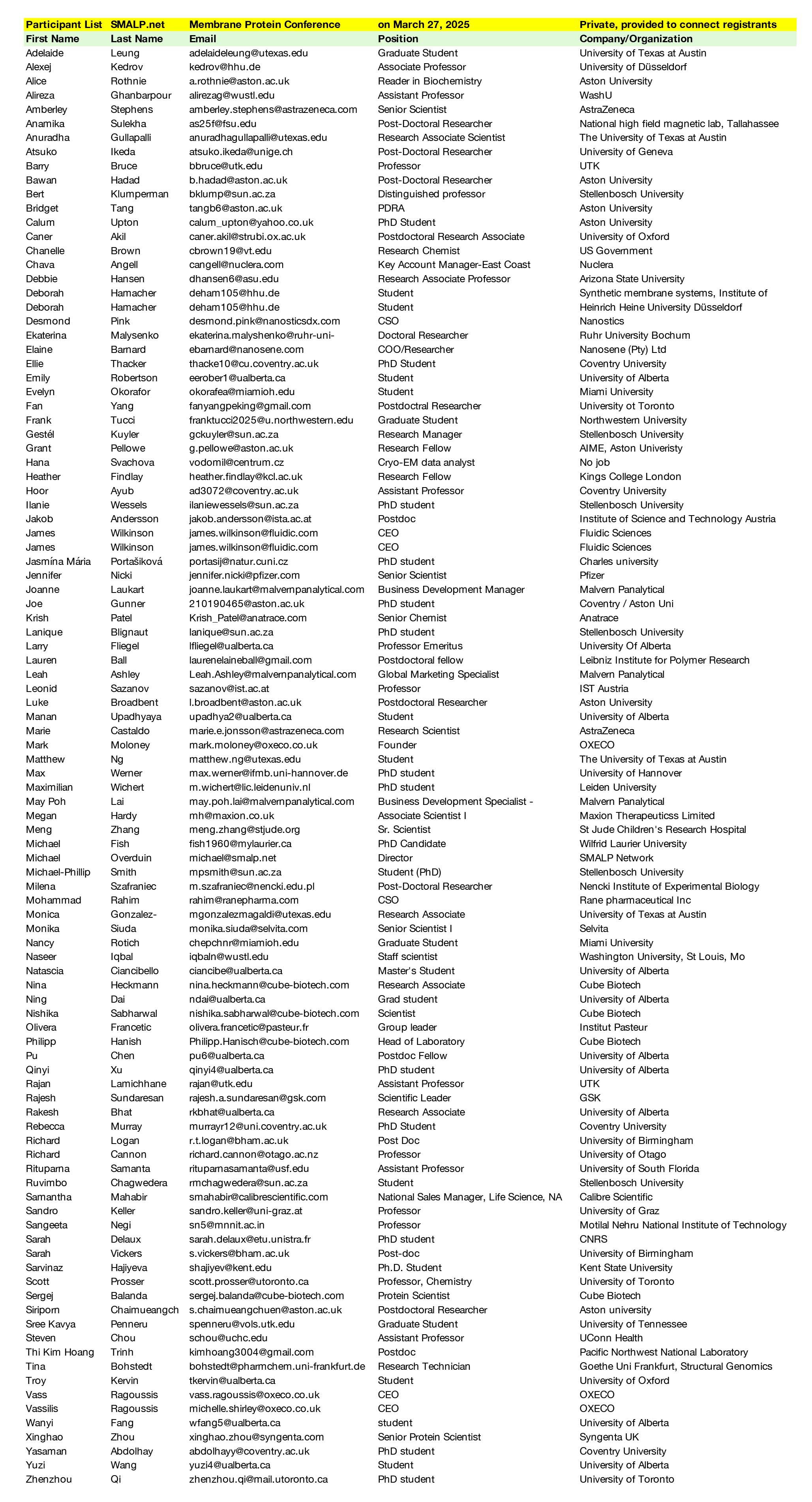
 Alexej Kedrov, Associate Professor, University of Düsseldorf on the assembly and gating mechanism of the Pel exopolysaccharide export complex PelBC of Pseudomonas aeruginosa
 Caner Akil, Postdoctoral Research Associate with Peijun Zhang, University of Oxford, on Unveiling the Complete Spectrum of SARS-CoV-2 Fusion Stages by In Situ Cryo-ET.
Philipp Hanish, Head of Laboratory, Cube Biotech will present Optimizing membrane protein characterization with NativeMP and Multiplexing Optical Methods
 Alice Rothnie, Reader, School of Biosciences, Aston University on novel polymers variants for membrane protein solubilisation and purification, including benzylamine-modified SMA polymers
 Lauren Ball, Alexander von Humboldt Postdoctoral Research Fellow, Stellenbosch University will present on the untapped potential of double hydrophilic block copolymers for the solubilization and surface immobilization of membrane proteins
 Frank Tucci, PhD student with Amy C. Rosenzweig Northwestern University, on the structures of methane and ammonia monooxygenases in native membranes in PNAS USA.
 Michael Fish, PhD Student with Matt Smith, Wilfrid Laurier University will present TOC159 Receptors & the Role of Galactolipids in Chloroplast Outer Membrane Targeting, and published a related manuscript in bioRxiv.
 Alireza Ghanbarpour, Assistant Professor, WashU, on an asymmetric nautilus-like HflK/C assembly controls FtsH proteolysis of membrane proteins, which is in press in EMBO J.
 Monica Gonzalez-Magaldi, Research Associate, The University of Texas at Austin: published the structure and organization of full-length Epidermal Growth Factor Receptor in extracellular vesicles by cryo-electron tomography
 Rituparna Samanta, Assistant Professor, University of South Florida: published Advancing Membrane-Associated Protein Docking with Improved Sampling and Scoring in Rosetta
Chat from Membrane Protein Conference on March 27, 2025
01:10:16 Michael Overduin: Alexej: Are any Pel - MSP interactions evident that could affect protein activity as well as stability? Do any involve specific lipids that are resolvable?
01:16:07 Philipp Hanisch: Yeah the Screening will be it!
01:16:33 Philipp Hanisch: We can have a Chat separate if you want Alexej
01:17:03 Gestél Kuyler: Reacted to "Yeah the Screening w..." with 👍
01:17:16 Debbie Hansen: Great talk, Alexej. Since you used protein nanodiscs, what lipid fraction did you introduce with the nanodiscs, a whole membrane fraction (inner & outer membranes) or just an outer membrane fraction?
01:19:29 Michael Overduin: Please ask Caner questions here.
01:19:43 Alexej Kedrov: Replying to "Great talk, Alexej. ..."
Thanks Debbie! Here, only phospholipids were used, POPC:POPG in ratio 7:3. So, we have a asymmetric membrane. That was a motivation to perform MD simulations in different environments, incl. LPS
01:21:42 Alexej Kedrov: Replying to "Yeah the Screening w..."
So yeah, we actually used the maxi-kit here, with isolated outer membranes - and a number of polymers seemed to work. Ultra Amphipol simply gave the most clear signal for both PelB and PelC on SDS-PAGE, so we continued with it
01:22:59 Philipp Hanisch: Replying to "Yeah the Screening w..."
The biggest "blob" unfortunately does not Always correlate with the best suited sample, especially for cryo EM. did you do any biophysics with the elutions?
01:25:53 Alexej Kedrov: Replying to "Yeah the Screening w..."
Well, as I (very fastly) said, we saw multiple "donuts" of PelC in the negative stain, so it seemingly worked. Probably, too low concentration or something with sample blotting for cryo-EM. No worries here yet - has to be repeated
01:28:11 Philipp Hanisch: Reacted to "Well, as (very fastl..." with 👍
01:31:57 Scott Prosser: Is the density of ACE2 important and what is the relative density of ACE2 in lung epithelial cells?
01:34:05 Rajesh Sundaresan: Hi Caner do you need a minimum number of events/interactions per VLP/virion particle in order to get good tomogram averages?
01:34:25 Michael Overduin: Do you see lateral spike interactions with lipids as the trimer lies flat on membranes during early fusion?
01:36:00 Alexej Kedrov: Replying to "Great talk, Alexej. ..."
sure, "symmetric membrane" :-)
01:37:35 Debbie Hansen: Reacted to "Thanks Debbie! Here,..." with 👍
01:37:39 Debbie Hansen: Reacted to "sure, "symmetric mem..." with 👍
01:41:52 CANER AKIL: Replying to "Do you see lateral s..."
We saw lateral spike interactions, sometimes dimer, trimer and even looks like “ring fence “
01:44:26 Michael Overduin: Please ask Philipp questions here.
01:56:14 Michael Overduin: Is it possible to predict which polymer is best for a given protein, e.g. based on predicted surface charge or hydrophobicity in AlphaFold models? Has AI been applied to this problem?
01:56:22 Ekaterina Malysenko: Thank you for the great insights, Philipp. One question regarding your suggestion to screen for successful protein elution instead of solubilization efficiency: What could be causes for obscured target protein bands in solubilization screens? We usually rely on protein precipitation whenever we suspect the copolymer to interfere with antibody or dye binding.
01:56:28 Rajesh Sundaresan: Hi Philip do you see differences in global Tm profiles seen for copolymer encapsulated proteins versus detergent solubilised proteins, in general?
01:57:42 Debbie Hansen: Great talk Philipp, thanks for all the developments!
01:58:56 Youzhong Guo: Did you see lipid density in the solved cryo-EM structure? That is beyond 3 Angstrom.
02:02:10 Rituparna Samanta: Philip, great talk. How do you generate the library of monomers?
02:03:02 Philipp Hanisch: Replying to "Thank you for the gr..."
precipitation is a good take to evade this issue but this still doesn't give you insights into the biophysics of the particle. If there is not such a strong time restriction this will be fine but if you Need to be fast and want data quickly in my opinion going "all the way" is the best shot.
02:03:57 Alexej Kedrov: Replying to "Alexej: Are any Pel ..."
Michael, for the lipids, we see plenty of "fragments", like an acyl chain, so they are quite flexible. But one lipid (sitting in a deep pocket between PelB and PelC) is nicely resolved, with PE as a best fit, but others (PG, PC) cannot be excluded.
02:04:34 Philipp Hanisch: Replying to "Hi Philip do you see..."
Oh yes, we have a great example for an ion channel where in detergent it is stable until 45 Degrees celcius and in polymers it does not aggregate/desintegrate at all over the temp ramp. I couldn't believe this but it stood true for several purifications.
02:04:42 Philipp Hanisch: Replying to "Great talk Philipp, ..."
thank you so much
02:05:35 Philipp Hanisch: Replying to "Philip, great talk. ..."
I am not sure I understand what you mean, can you specify?
02:06:11 Sarah Delaux: Do you have a way to assess the lipid/ polymer content?
02:06:39 Philipp Hanisch: Replying to "Did you see lipid de..."
let me cross check with our cryo em expert but as far as I remember he did indeed see densities that very well could be lipid derived.
02:07:13 Michael Overduin: Please ask Alice questions here.
02:08:44 Scott Prosser: Is there a range of [Mg] that is survivable in SMA-2000?
02:09:16 Youzhong Guo: Replying to "Did you see lipid de..."
Thanks. It will be great to see lipids at this resolution.
02:09:28 Rituparna Samanta: Replying to "Philip, great talk. ..."
Sorry. for all the different copolymers you have shown were there different monomers used or SMA.
02:09:49 Becky Murray: Alice - Any insights into why AQP4 was so different to solubilise than the other proteins you tested in terms of solubilisation efficiency?
02:10:00 Michael Overduin: Alice: Is the enhanced Mg2+ sensitivity due to the additional hydrophobicity? The derivitization of the maleic group would otherwise be predicted to reduce Mg++ sensitivity, assuming this reaction went to completion, right?
02:13:03 Rajesh Sundaresan: Replying to "Hi Philip do you s..."
Thanks, I think I did hint at this a few meetings ago, we could not denature the TMs of proteins encapsulated in SMA or DIBMA.
02:13:40 Becky Murray: Alice - with the a-olefin MA polymers, any indication of different nanodiscs sizes with the different sizes?
02:15:28 Michael Overduin: Alice: are the long acyl chains of the olefin MA’s destabilizing to TM helical bundles?
02:16:23 Philipp Hanisch: Replying to "Hi Philip do you see..."
Yes I heard the same from a few scientists so far. Why that is and if this is an advantage we need to determine still.
02:22:45 Michael Overduin: Please ask Lauren questions here.
02:25:47 Michael Overduin: Lauren: what is the biocompatibility / toxicity profile of the hydrophilic block and diblock polymers?
02:30:22 Alice Rothnie: Replying to "Alice - Any insigh..."
We thought it might be that AQP4 has a particular lipid environment that affects its solubilisation. Alternatively it could be related to the fact that AQP4 can form protein arrays.
02:32:06 Becky Murray: Reacted to "We thought it might ..." with 👍
02:44:33 Alice Rothnie: Replying to "Is there a range o..."
It will tolerate concentrations below 3-4mM, but it is likely the polymer sequesters a lot of the Mg2+ at these concentrations, even if it isn't precipitating out of solution, so problematic if you need the Mg2+ for your reactions
02:48:02 Michael Overduin: Please ask Frank questions here.
02:49:15 Philipp Hanisch: Replying to "Philip, great talk. ..."
We used all 5 Copolymer backbones we offer in our experiments: SMA, DIBMA, AASTY, Ultrasolute Amphipol and Cubipol
02:54:00 Michael Overduin: Frank: Is pH and divalent cation concentration critical for pMMO assembly in vivo or from detergent preps? Has the TFE site been exploited for inhibitor design?
02:55:55 Michael Overduin: Is the cofactor likely to be one phospholipid or a pair of lipids bound together?
02:57:43 Michael Overduin: Our next MPC will be on Tuesday June 24, 2025. Thanks for voting!
02:57:59 Gestél Kuyler: Reacted to "Our next MPC will be..." with 🎉
03:04:19 Michael Overduin: Feel free to ask Michael questions here.
03:17:28 Michael Overduin: Frank: Is there quantitative data on lipid specificity of the C-terminal targeting elements individually or in the FL protein?
03:26:33 Michael Overduin: Feel free to ask Alireza questions here.
03:26:41 Frank Tucci: Replying to "Frank: Is pH and div..."
pH and redox environment are expected vary on either side of the native membrane in vivo, meaning the periplasmic and cytoplasmic regions of pMMO would see very different environments. These factors are likely important for function in vivo, and we are in the process of learning how we can mimic this kind of gradient in vitro.
03:29:15 Frank Tucci: Replying to "Frank: Is pH and div..."
TFE itself inhibits activity, although our main goal in using TFE was to identify the region of the protein where substrate may bind and be converted to product. By identifying the TFE binding site as the active site, we are now examining this part of the protein to see if it can inform the design of pMMO-inspired catalysts or give us clues about which residues are important for catalysis.
03:33:25 Frank Tucci: Replying to "Is the cofactor like..."
The unidentified molecule I mentioned is partially embedded in the native membrane and is partially bound to the periplasmic region of the protein. We actually suspect that the periplasmic region may be a peptide or a portion of a protein based on its shape—it forms an extended beta sheet motif with pMMO. More generally speaking, we suspect that the composition of the lipid environment itself is an important “cofactor” by increasing the solubility of methane and stabilizing the pMMO transmembrane regions. The native membrane also contains quinols, which may be important cofactors that deliver electrons to pMMO, a requirement for activity.
03:35:30 Michael Overduin: Alireza: is the twist in the bound membrane due to protein electrostatic or hydrophobic interactions or lipid asymmetry in the bilayer (or both)?
03:39:20 Michael Overduin: Is the unique solubilization ability of carboxy-DIBMA possibly due to its additional charge being required to solubilize this huge structure with its large, empty vestibule?
03:39:51 Sree Kavya Penneru: @Michael Fish, Do you know if it is necessary for both GTPases to have A-domains for them to heterodimerize?
03:42:07 Michael Fish: Replying to "@Michael Fish, Do yo..."
Hi Sree, Only the TOC159 GTPases have A domains, not the TOC33 GTPases which are the other pair in the heterodimer. Still, the A domain is not required for heterodimerization, but when included prevents the heterodimerization of certain GTPase pairs.
03:44:28 Scott Prosser: Apologies if I missed this…But can you capture substrate analogs in the cage via cryoEM time series?
03:46:17 Sree Kavya Penneru: Replying to "@Michael Fish, Do yo..."
Got it, thanks!
03:46:22 Sandro Keller: @Michael: It’s overall electroneutral.
03:48:09 Michael Overduin: Please ask Monica questions here.
04:00:48 Michael Overduin: Monica: are a pH gradient and lipid asymmetry maintained in the EGFR-EV structures?
04:00:54 Rajesh Sundaresan: Hi Monica can you comment on the yield and expression of targets multi TMs using the Hoffman et al fusion sequence. Also have you tried attaching the Hoffman fusion sequence onto the intracellular end of N-terminus of multi-TM proteins?
04:01:44 Rituparna Samanta: Was the structure seen without ligands or different kinds of ligands?
04:02:53 Scott Prosser: Thanks a lot! Does ESCRT ever help with yield for cryoEM studies of proteins?
04:25:30 Michael Overduin: Please ask Rituparna questions here.
04:26:03 Michael Overduin: Does MPDock correctly refine complexes of TM beta barrel complexes?
04:28:13 Michael Overduin: Can different bilayer types (charge, head groups, asymmetry) accommodated by MPDock during refinement?
04:32:34 Rajesh Sundaresan: Hi Rituparna not a scientific question, how do you manage to attract funding in this dynamic field competing against the likes of DeepMind, Amazon and EMBL-EBI etc..
04:32:37 Scott Prosser: It would be cool to see what happens to aggregates of viral proteins that undergo the type 1 fusion mentioned earlier
04:36:50 Scott Prosser: Thanks Michael and speakers!
04:37:15 Manan Upadhyaya: Thank you to all the speakers, for the great presentations!
04:37:50 Debbie Hansen: thank you, Michael!!
04:38:09 CANER AKIL: Thanks, Michael !
04:38:22 Milena Szafraniec: Thank you very much!
04:38:22 Rajesh Sundaresan: Thank you all.
04:38:22 Evelyn Okorafor: Thank you Michael
04:38:28 Adelaide Leung: Thank you!
04:38:29 Rituparna Samanta: Thank you for the invitation.
04:38:30 Krish Patel: Thank you all
04:38:33 Calum Upton: Thank you
04:38:59 Nancy Rotich: Thank you all
04:39:36 Alireza Ghanbarpour: Thanks!
October 13, 2024 videos for MPP2024 Registrants
 Claire Naylor, Quantifoil: Delivering consistent and efficient imaging for single particle analysis (SPA) with HexAuFoil® sample supports.
 Jim Reid, Senior Principal Scientist - Protein Biology, Domainex: Fragment Screening of Adenosine A2a Receptor using Polymer-Encapsulated Nanodiscs
 Francisco Barrera, Associate Professor, UTK: Cholesterol Controls the Assembly and Activity of the EphA2 Receptor
Frank Bernhard, PI, Goethe University Frankfurt: Cryo-EM structures of cell-free synthesized GPCR/G protein complexes in nanodiscs
 13:50 Evelyn Okorafor, Miami University, Oxford: Investigating The Charge Effect of SMA Derivatives On The Membrane Bilayer Using Solid-State NMR
June 18, 2024 Registrants
 Adam Evans, PhD student with Tim Dafforn at U Birmingham, on Optimising the Purification Process: Exploring Affinity Resins and Polymer Combinations using the RePol Screen.
00:52:16 Gestél Kuyler: Please post your questions for Adam here in the chat
00:54:05 Brian Cieslewicz: Were these extractions from whole cell lysates or from isolated membranes?
00:55:11 Yu-Fu Hung: what brand of Ni-Sepharose did you use?
00:55:32 Erwin Lamping: Qre these batch or column elutions of the membrane proteins?
00:56:04 Becky Murray: What polymer concentration did you use for solubilisation? Could that impact how much protiein you soluilise and how it purifies?
01:01:09 Troy Kervin: Comment: we need a resin screening kit to accompany polymer screening kit. Do not want to buy an entire bottle of resin just for a screen
01:01:10 Krishnakant (Krish) Patel-Anatrace: Have you used other SMA polymers other than those that were presented ?
01:01:28 Brian Cieslewicz: Did you see if extraction efficiency correlates with protein stability/TM?
01:01:39 Debra Hansen: Great talk! Very helpful.
01:02:46 Krishnakant (Krish) Patel-Anatrace: Reacted to "Comment: we need a..." with 👍
01:02:51 Barry Bruce: did you even Passivate the matrix with free polymer prior to purification?
01:03:13 Debra Hansen: Reacted to "Comment: we need a r..." with 👍
01:04:22 Adam Evans: Replying to "Were these extractio...": This was from isolated membrane
01:04:32 Brian Cieslewicz: Reacted to "This was from isolat..." with 👍
01:04:40 Adam Evans: Replying to "Were these extractio...": which is more necessary for bacterial expression, but maybe not so much for mammalian stuff
01:05:12 tim dafforn: Replying to "Comment: we need a r...": Perhaps something Cube might Want to consider? Cube... Happy to discuss
01:05:31 Adam Evans: Replying to "what brand of Ni-Sep...": This was Cytiva's Ni-Sepharose High Performance resin
01:05:49 Adam Evans: Replying to "Qre these batch or c...": Using a 96 well filter block, this was done in batch elutions
01:05:58 tim dafforn: Replying to "Have you used other ...": As Adam said, we haven't mainly due to resource (including Adam's time) but it is something we could be interested in
01:06:10 Adam Evans: Replying to "What polymer concent...": 2.5% as following Cube Biotechs protocol
01:06:15 tim dafforn: Replying to "Did you see if extra...": Not really.. But we could look a bit more
01:06:44 tim dafforn: Replying to "did you even Passiva...": No so there will be a bit of adsorbance onto the column
01:07:02 Surbhi Dhingra: Do you dilute the proteins post solubilization to reduce the amount of unused polymer that could affect resin binding?
01:07:12 Adam Evans: Reacted to "Great talk! Very hel..." with ❤️
01:08:36 Adam Evans: Replying to "Do you dilute the pr...": To keep it in a 96 well, high-throughput context the samples weren't diluted.
01:14:15 Krishnakant (Krish) Patel-Anatrace: Reacted to "As Adam said, we h..." with 👍
01:14:25 Andy O'Reilly: Great talk! Can I ask what the problem is with your protein being expressed in the wrong compartment in SF9 cells? Can the protein not be purified from those subcellular compartments?

 Alex Snow, Postdoctoral Researcher, and Tharushi Wijesiriwardena, Research Technician with Stephen Muench University of Leeds Astbury Biostructure Laboratory on Incorporating SMALPs into a novel cell-free system
01:16:29 Rakesh Bhat: What promoter you are using and have you tried to change it?
01:19:12 Claire Coupland: Hi, great talk. I was wondering with the cryoEM, it looks like you might have some flexibility between the domains. Do you have any plans for how you might deal with that in the data processing?
01:22:44 Alex Snow: a.snow@leeds.ac.uk if you have any questions later on :)
 Claire Coupland, Postdoctoral Researcher with John Rubinstein, The Hospital for Sick Children, on cryo-EM of V-ATPase in native synaptic vesicles
01:41:15 Barry Bruce: very nice Talk- It would appear you observe no ATPase dimers despite the highly curved vesicle surface
01:42:25 Erwin Lamping: What type of size exclusion did you use for the synaptic vesicles.
01:44:39 Erwin Lamping: Great talk, thanks
01:51:01 Francoise Koumanov: Hi Claire , great work. How much vesicles (e.g. from how many brains) do you need to get a good size exclusion purification for CryoEM?
01:54:37 Claire Coupland: Replying to "Hi Claire , great wo...": Thank you! We actually just used one brain per purification. However, this was very low yield and we only got around 50 mAU peaks despite having an AKTA PURE equipped with a longer wavelength UV detector
01:59:45 Claire Coupland: Great talk Wan! I was wondering how you performed your particle picking/identification from your dataset?
02:00:51 Ryan Karimi: Hello, great talk! I’m wondering about whether sample thickness was a challenge in acquiring micrographs, and whether specialized grids (i.e. support films) were necessary for imaging whole mitochondria?
02:01:08 Michael Overduin: Wan: what size of disc would be most useful to resolving natively curved bilayers with your protein complex states?
02:02:17 Tomas Heger: Replying to "Hi Claire , great wo...": Did you also need to use any stabilizers such as glycerol or sucrose to keep the vesicles intact? If yes, what is the best way to get rid of them before cryo, from your experience? Thank you!
02:02:29 Francoise Koumanov: Replying to "Hi Claire , great wo...": Thank you. It's amazing that you manged to have a very homogenous population. We are trying to isolate glucose transporter vesicles from adipose tissues but I think there are even less abundant than the synaptic vesicles. I will look forward to read your paper.
02:09:18 Claire Coupland: Replying to "Hi Claire , great wo...": @Tomas Heger Thanks for your question. I know that glycerol is important for certain types of vesicles and can improve stability and reduce aggregation. However, we found that we didn't need to use any additional stabilisers with our synaptic vesicles. For us, the amount of time that the vesicles spent between being in vivo and on grid seemed to be the most important in keeping the vesicles intact.
02:11:45 Tomas Heger: Replying to "Hi Claire , great wo...": Thank you very much for sharing your insights, amazing work!
02:13:11 Claire Coupland: Replying to "Hi Claire , great wo...": @Francoise Koumanov Thank you! We are lucky that synaptic vesicles are so abundant and uniform in brain tissue. It definitely helps with purification and data processing. Good luck with your glucose transporter vesicles!
02:14:40 Barry Bruce: both your work and Alexy Amounts observe a tetramerization induced curvature of the Cristae yet his was with the ATPase and yours was the supramolecular complex
Wan Zheng, Postdoctoral Associate with Kai (Jack) Zhang, Assistant Professor, Yale U: In-situ Structures of Mammalian Mitochondrial Respiratory Supercomplexes in Reaction within Native Mitochondria
03:28:51 Jack Zhang: Replying to "Great talk Wan! I wa...": Great talk Wan! I was wondering how you performed your particle picking/identification from your dataset?
Hi Claire, this is Wan's PI. Thank you so much! There are quite a few cycles of particle sorting. We originally focused on special features of CIII region, which helped with the particle enrichment
03:31:26 Claire Coupland: Replying to "Great talk Wan! I wa...": Thank you! If I may ask a further question, what are the features of the CIII region that you can pick up on? Or is it more that all membranes are picked and then the 2D classes containing features can be identified from these?
03:31:33 Jack Zhang: We used normal cryo-EM grids. Sample thickness is indeed a challenge, but you can always find thinner regions and select them manually
03:33:29 Jack Zhang: Replying to "Great talk Wan! I wa...": Thank you! If I may ask a further question, what are the features of the CIII region that you can pick up on? Or is it more that all membranes are picked and then the 2D classes containing features can be identified from these?
It is characterized by a concave shape of the membrane surrounding CIII. Yes, you can distinguish key features, but this was quite empirical. We originally didn't know that was CIII
Troy Kervin, PhD Student with Peijun Zhang at U Oxford published how membranes are functionalized by the proteolipid code and will present "Open questions about membrane zonation"
02:28:40 Peter Tieleman: RNA has a clear code with 4 bases. What do you imagine is the basis for a ‘proteolipid’ code?
02:32:38 Troy Kervin: troy.kervin@magd.ox.ac.uk
02:33:34 Peter Tieleman: Ockham might be rolling over in his grave
02:34:00 Febin Varghese: Reacted to "Ockham might be roll..." with 😂
02:34:32 tim dafforn: Reacted to "Ockham might be roll..." with 👍
02:34:57 Troy Kervin: Reacted to "Ockham might be roll..." with 👍
 Noemi Jiménez-Rojo, Ikerbasque Research Fellow, Dept of Biochemistry, UPV/EHU, who published on cracking the membrane lipid code
02:47:34 tim dafforn: don't forget to put questions for Noemi in the chat
02:52:05 Paul Whitley: When you increase membrane fluidity have you looked to see if homeostatic mechanisms such as SREBP cleavage occurs?
02:56:39 Erwin Lamping: How do changes to membrane fluidity affect protein function and may those changes play a role in your observations as well, rather than just the changes of fluidity causing those changes.
 Peter Tieleman, Professor, University of Calgary and Canada Research Chair in Molecular Simulation, on membrane modeling and fingerprinting
03:16:57 Isabel Materon: Very interesting talk. Regarding the unique lipid content around proteins (fingerprints), do you see or anticipate repeats of these fingerprints across the entire lipid bilayer surface? If so, how closely located are they to one another?
03:17:17 Fidaa Ali: Could you please provide some guidelines on how to choose the correct membrane size for different protein sizes to study membrane lipid properties around the protein ?
03:17:37 Michael Overduin: Should a comprehensive membrane model also address non-bilayers like fission and fusion intermediates or lipid droplets?
03:18:29 Michael Overduin: Should the sorting, assembly and activation of membrane proteins be accurately predicted by such a membrane model?
03:19:32 Paul Whitley: On the early graph (if I understand correctly), PIPs seemed more enriched around protein than in bulk lipid. Did your starting membrane have PIPs in both leaflets? If so did PIPs only cluster on inner leaflet?
03:20:48 Michael Overduin: Do the fingerprints of a TMP differ fundamentally from those of a membrane reader such as a phosphoinositide-specific FYVE, PX, PH or C2 domain?
 Garth Nicolson, President, The Institute for Molecular Medicine on the updated Singer-Nicolson Fluid-Mosaic Model of Cell Membranes
 Satyajit Mayor, Professor, National Centre for Biological Sciences, Bangalore, India on membrane organization, models and nanoclusters
Chat space: closing comments on June 18, 2024
03:33:33 tim dafforn: thanks Michael!!! fantastic as ever
03:34:01 Claire Coupland: Thank you all! Great meeting
03:34:02 Adam Evans: Thanks everyone!
03:34:09 Isabel Materon: Thank you for organizing!
03:34:13 Debra Hansen: Great meeting, thanks again!
03:34:16 Erwin Lamping: thanks for some great talks
03:34:44 Tina Bohstedt: Thanks for the great meeting!
03:34:50 Francoise Koumanov: Thank you for a great meeting!
03:34:53 Wan Zheng: Thanks for the great meeting!
03:34:55 Paul Whitley: Thanks
03:34:58 Krishnakant (Krish) Patel-Anatrace: Thanks to all the presenters for some wonderful talks.
03:35:03 Alexandra Gaiffe: Thanks !
03:36:00 Krishnakant (Krish) Patel-Anatrace: Thank you for organizing today's webconference.
Videos for SMALP Conference on March 12, 2024
 Ci Chu, PhD student, Heinrich-Heine-University, on capturing GPCRs into native lipid-bilayer nanodiscs using DIBMA copolymers.
 Michael Erkelenz, Chemist, Cube Biotech on A new multimodal memtein copolymer platform.
 Jelger Risselada, Dept of Physics, TU Dortmund University, on Membrane facial recognition: How proteins actually see cholesterol.
 Marzieh Tabefam, Ph. D. student, WLU, on exploring theiInterconnection of Mitochondrial Carrier Proteins Involved in Energy Transfer.
 Ayyalusamy Ramamoorthy, Professor, Florida State University, on detergent-free membrane protein isolation using nanodisc-forming polymers.
 Elissa Moller, PhD student, NICHD, on using cryo-EM and polymers to resolve structures of mechanosensitive channels.
 Peter Kim, Ph.D. Student, University of Toronto, on structures of channel rhodopsin paralogs in peptidiscs and their ion selectivities.
 Wayland Cheng, Associate Professor, Washington University, on nanodisc scaffold and size altering ligand-gated ion channel structures.
Brian Adair, Instructor at Harvard Medical School, on cryo-EM structures of human integrins in native lipids.
Chat conversations in the SMALP webconference on March 12, 2024:
01:04:08 Michael Overduin: Feel free to ask Ci Chu questions here.
01:05:58 Hector Ariel Roldan, Dr: Is mPeg4-dibma electroneutral?
01:07:00 Jen: what temperature was the solubilization performed at?
01:08:20 Philipp Hanisch (Cube): Is there in example where Ligand binding of a GPCR failed in other polymers but worked in your new polymer?
01:08:34 Ruby Huynh: Why did you choose DIBMA over other polymer?
01:09:34 Tamara Miljus: Thank you for the nice talk! Have you checked if your receptor can be activated in DIBMA or your new polymers?
01:10:26 Nathan K: Can you provide a link to the paper?
01:12:41 Eve: Thank you, from your research do you suggest we use negatively charged polymer or electroneutral polymers for membrane proteins? Also, did you try other lipids in your study asides DMPC?
01:13:44 Michael Overduin: Next SMALP conference will be by zoom on Tuesday June 18, 2024
01:16:32 Gestél Kuyler: Reacted to "Next SMALP conferenc..." with 👌
01:17:29 d.wright: Reacted to "Next SMALP conferenc..." with 👍
01:17:40 Manuel Etzkorn: Here the link to Ci’s preprint, enjoy reading and feel free to comment: https://www.biorxiv.org/content/10.1101/2024.01.20.576420v1
01:18:08 Alexej Kedrov: Reacted to "Here the link to Ci’..." with 👍
01:18:23 stemuench: Reacted to "Here the link to Ci’..." with 👍
01:24:13 Manuel Etzkorn: Replying to "Thank you, from your..."
We see higher solubilisation yield for our protein in the new mPEG version. The other parameters we tested are similar in sulfo-DIBMA. We used DMPC and DMPG for im vitro assembly.
01:24:42 Praneetha Sundar Prakash: Reacted to "Here the link to Ci’..." with 👍
01:24:53 Praneetha Sundar Prakash: Reacted to "Next SMALP conferenc..." with 👍
01:26:23 Eve: Replying to "Thank you, from your..."
ok... was there a difference in DMPC and DMPG lipid bilayers due to charge of the mPEG dibma charge?
01:29:51 Jana Susanne Anton: How come the absorption is so low in the SEC (slide 17). We were observing similar absorptions in the past with SMA.
01:30:14 Rajesh: Reg Biotin-Cubipol: Thank you for adding Biotin moiety. Is the biotin at 1:1 ratio with PIMA, and do you have any examples of moles biotin in an extracted protein wrapped with Biotin-Cubipol.
01:30:48 Katherine Zhao: Reacted to "Here the link to Ci’…" with 👍
01:31:53 Alice Rothnie: What is the ratio of fluorophore to polymer?
01:33:52 Doreen Matthies: Can you run your purified G6PC on Native-PAGE?
01:36:59 Michael Overduin: Feel free to ask Jelger questions here.
01:37:18 Michael Erkelenz: Replying to "What is the ratio of..."
The Ratio of fluoresceine to Copolymer is 1. So one fluorophor per chain. This ensures no cluster forming by the hydrophobic fluoresceine.
01:37:31 Alice Rothnie: Reacted to "The Ratio of fluor..." with 👍
01:38:33 Michael Erkelenz: Replying to "Reg Biotin-Cubipol: ..."
We will presumably Show more data related to this Topic at our next masterclass. Of Course, you are invited to have a look
01:39:16 Philipp Hanisch (Cube): Replying to "Can you run your pur..."
I jump in for Michael Erkelenz here: We did not try to run G6PC in specifically on Native Page but did this with several other targets in a broad range of polymers and detergents. In my personal expirience it can be quite tricky to get reliable data even when using the published SMA PAGE Approach so i am not a huge fan of Native Page when working with Membrane Proteins. What are your expiriences?
01:39:27 Michael Erkelenz: Reacted to "I jump in for Michael..." with 👍
01:40:37 Philipp Hanisch (Cube): Replying to "Reg Biotin-Cubipol: ..."
the masterclass will be held on 10. or 11.4.24. you can soon Register via our Homepage :D
01:41:43 Doreen Matthies: Replying to "Can you run your pur..."
We have issues with getting some of our polymer samples into NATIVE-PAGE but have no problem when using detergents or MSPs. Elissa will mention that later also and would like to understand why.
01:49:04 Ayyalusamy Ramamoorthy: Is the cholesterol binding independent of the lipid composition?
01:49:30 Ayyalusamy Ramamoorthy: Do curvature inducing lipids influence cholesterol binding?
01:49:51 Renata Bilewicz: what about cholestenone (product of oxidation) interactions in the membrane?
01:50:08 MARTA BARNIOL XICOTA: Did you identify any proteins containing this CHO-attracting sequence and if so, are there any CHO-interactions reported with that protein?
01:50:44 Rajesh: How does your optimal TM domain compare to existing protein database on single pass TM proteins
01:54:09 Jelger: Herre Jelger risselada
01:57:10 Michael Overduin: Feel free to ask Marzieh questions here.
02:00:58 C. Chu: Replying to "Thank you, from your..."
Thanks, we also tried POPG and POPC. All worked well. We only used DMPC for differential scanning calorimetry (DSC) measurement.
02:01:55 Rajesh: Trivia for SMALP attendees: Wilfrid Laurier was Michael Overduin's Alma Mater for Undergrad!😀
02:02:13 Debbie Hansen: Reacted to "Trivia for SMALP att..." with 👍
02:04:11 Michael Overduin: WLU in Waterloo, Ontario, Canada is hosting a free protein symposium on May 31, with John Rubinstein giving the keynote. See https://www.eventbrite.ca/e/tri-university-protein-symposium-tups-2024-tickets-826825977757
02:04:16 Doreen Matthies: Was the tetrameric form SDS stable or did you have to crosslink?
02:04:36 Michael Overduin: Feel free to advertise jobs and student opportunities here.
02:05:11 Doreen Matthies: How did the detergent solubilized proteins look on NATIVE PAGE or SEC?
02:10:14 Doreen Matthies: Replying to "Was the tetrameric f..."
I see now, it is semi-NATIVE PAGE
02:11:20 Doreen Matthies: Can you pull down heterotetramers from the inner mitochondrial membrane?
02:13:45 Andres Cabezas: Did you use polymers at all during the initial protein purification steps? I know ultimately you used detergent to solubilize the membrane proteins, I am wondering if you can use detergent with polymer-solubilized proteins right before the proteoliposome reconstitution step.
02:15:03 Tomáš Heger: Replying to "Was the tetrameric f..."
Could you please explain what you mean by "semi-native"?
02:17:25 Michael Overduin: Questions for Rams?
02:18:16 Marzieh Tabefam: Replying to "Was the tetrameric f..."
Yes, semi-native condition has less SDS percentage on the gel compare to the denaturing condition, and no SDS in loading buffer and running buffer. Does this what you ask for?
02:19:00 Tomáš Heger: Reacted to "Yes, semi-native con..." with ❤️
02:19:12 Tomáš Heger: Replying to "Was the tetrameric f..."
Yes, thank you!
02:28:23 Alexander Nevzorov: Rams: Are the peptides indeed pointing perpendicular to the membrane surface according to your picture? That would appear to break the “belt” hypothesis.
02:29:08 Marzieh Tabefam: Replying to "Did you use polymers..."
Yes! detergent is kept all the way along the reconstitution process and it is removed by bio-beads at the step right before the proteoliposomes formation
02:32:17 Andres Cabezas: Replying to "Did you use polymers..."
If I understood correctly, did you use polymers to natively extra proteins from the e.coli membranes, and then introduced detergent to further solubilize the proteins and perform the subsequent proteoliposome steps?
02:40:23 Michael Overduin: Feel free to ask Elissa questions here.
02:40:28 Marzieh Tabefam: Replying to "Did you use polymers..."
No! we didn't use polymers in our work
02:40:40 (Rams) Ayyalusamy Ramamoorthy: Replying to "Rams: Are the peptid..."
Peptides are amphipathic and helical when bound to lipids as in nanodiscs. They are located at the rim of the nanodiscs with the hydrophobic face facing lipids chains.
02:40:49 (Rams) Ayyalusamy Ramamoorthy: Replying to "Rams: Are the peptid..."
Good question, Alex. Thanks.
02:41:20 Evelyn Okorafor: Rams: Did you test your charged polymers with charged lids asides dmpc?
02:41:44 Andres Cabezas: Replying to "Did you use polymers..."
Got it. Thank you! I wanted to make sure I didn’t miss something. I am doing work similar to yours. Nice talk 🙂
02:41:56 Evelyn Okorafor: Replying to "Rams: Did you test y..."
Rams: Did you test y...
02:42:19 Marzieh Tabefam: Replying to "Did you use polymers..."
Nice. thank you🙂
02:43:11 (Rams) Ayyalusamy Ramamoorthy: Replying to "Rams: Did you test y..."
We did with DMPG, POPC, POPG, E.coli lipids, etc. But, most of these data were not published.
02:46:05 Evelyn Okorafor: Replying to "Rams: Did you test y..."
Alright... Thank you...
02:46:31 Rajesh: Melissa: Do yo expect similar differences with lipid composition influencing structure and function of eukaryotic Aquaporins?
02:52:20 LG Zeng: Melissa: what were the chain length of your lipids?
02:52:23 Michael Overduin: Melissa: Did the multiple lipids bind as a set that may have been disrupted by the other polymers? Glyco-DIBMA is gentle.
02:52:39 Rajesh: Reacted to "Melissa: Did the mul..." with 👍
02:59:59 Michael Overduin: Feel free to ask Peter Kim questions here.
03:09:48 LG Zeng: Peter: I might have missed it. What was the number of amino acids/molecular weight of the peptides for your peptidiscs? And what is the size of the resultant discs? Thx.
03:12:08 Aeric Yue Zhou: Do all three protomers have to be activated before letting the K+ or Na+ go through?
03:13:18 Rajesh: Peter: That's a lot of fat (cholesterol) bound to KCR1🙂. Is it understood why Chol is tightly bound despite detergent extraction?
03:14:43 Michael Overduin: Peter: can you comment more on the nature of the protein-lipid head group and acyl chain interactions and the protein-peptidisc interactions?
03:22:08 Michael Overduin: Feel free to to ask Wayland questions here.
03:22:35 Peter (Kyumhyuk) Kim: Replying to "Peter: I might have ..."
The peptide length is 37 amino acids, and the molecular weight should be close to 4.5kDa
03:33:55 Rajesh: Wayland: Really enjoyed reading your paper. Were you able to see any bound lipids. Is there any preference for particular lipids with the different reconstitution formats.
03:38:52 Michael Overduin: Wayland: what are the scaffold interactions, e.g. scaffold aromatics pi interactions with transmembrane residues?
03:39:35 Johanna Syrjanen: Wayland: Is the positioning of ELIC to the side of the nanodisc affected by the lipid composition of the nanodisc?
03:39:47 Michael Overduin: Are there MSPs where the aromatic residues have been successfully eplaced with long chain aliphatic residues?
03:41:22 Tomáš Heger: Is the preferred localization of ELIC caused solely by interaction with MSP or does the membrane thickness also contribute?
03:41:24 Alexander Nevzorov: Great talk! Could you clarify why you observe membrane thickening for smaller disks?
03:42:18 Alexander Nevzorov: Is it protein-induced?
03:43:13 Ilia G Denisov: There is significant difference between nanodiscs and LUV. But real membranes contain 20%- 60% proteins by weight, is this a factor to consider?
03:49:44 Michael Overduin: Feel free to ask Brian questions here.
03:50:18 Michael Overduin: The student prize will be awarded after this talk. Thanks for voting!
04:01:02 Doreen Matthies: Did you try to collect Cryo-EM data at a tilt angle and did this improve your reconstruction?
Videos from SMALP Conference on June 15, 2023
 9:00 am MDT Kunyu Wang, a PhD student with Youdong Mao at State Key Laboratory for Mesoscopic Physics, School of Physics and Peking-Tsinghua Joint Center for Life Science, Peking University, Beijing, will present Using SMALP to discover native conformations of HIV-1 Envelop glycoprotein as appeared in Commun Biol.
 9:20 am Kirill Nadezhdin Postdoctoral Scientist and previously graduate student at Columbia University Irving Medical Center, who recently published on the structural mechanisms of TRPM7 activation and inhibition in Nature Communications.
Session 2 chaired by Philipp Hanisch, Cube Biotech
 9:45 am Willem Kegel, Professor Science Chemistry, Debye Institute for Nanomaterials Science Physical and Colloid Chemistry, University of Utrecht, who recently published on cooperative transitions involving hydrophobic polyelectrolytes such as polymers including SMA interacting with membranes in PNAS. Slides
 10:05 am Qun Liu, Principle Investigator, Biology Department, Brookhaven National Laboratory, will speak on cryo-EM structure analysis of small membrane proteins in polymer nanodiscs, with examples including two ~50 kDa proteins, the FtAlkBG enzyme and BbZIP zinc transporter.
Session 3 chaired by David Glück, Universität Graz
 10:50 am Piotr Koprowski, Assistant Professor, Laboratory of Intracellular Ion Channels, Nencki Institute of Experimental Biology PAS (Poland) who recently published on pharmacological characterization of mitochondrial ROMK2 potassium channels in lipid bilayers.
 10:30 am David Swainsbury, Lecturer in Biochemistry at University of East Anglia, who recently published on the cryo-EM structure of the four-subunit Rhodobacter sphaeroides cytochrome bc1 complex in styrene maleic acid nanodiscsin PNAS.
Session 4 Chaired by Rajan Lamichhane, University of Tennessee Knoxville
 11:15 am Moitrayee Bhattacharyya, Assistant Professor of Pharmacology, Yale University, who recently published on the determination of oligomeric organization of membrane proteins from native membranes at nanoscale-spatial and single-molecule resolution. (video truncated at the request of the presenter)
 11:35 am Luis Real Hernandez, PhD Student, University of Virginia has recently published Lipid packing is disrupted in copolymeric nanodiscs compared with intact membranes in the Biophys J.
Chat conversations in the SMALP webconference on June 23, 2023:
09:01:14 From Michael Overduin to Everyone:
Feel free to ask Kunyu Wang questions here
09:12:05 From Tomáš Heger to Everyone:
Thanks for your talk! Was cross-linking crucial for getting the desired conformation?
09:12:09 From Alison Varghese to Everyone:
I'm not familiar with using SMALPS. What concentrations and scale are we talking about?
09:12:42 From Alexandre Slater to Everyone:
Hi Kunyu, great talk. I wonder how homogeneous the glycan chains are? Do the chain lengths vary between protein molecules or are they always uniform?
09:16:32 From Philipp Hanisch to Everyone:
Thank your for the great talk. Late night Special. Did you check both Proteins solublized at 4°C and RT in Cryo EM? Did you see a difference? Was there a difference in solublization efficiency and elution quantity for the two temps?
09:18:07 From Alison Varghese to Everyone:
OK thank you.
09:18:26 From Michael Overduin to Everyone:
Kunyu’s pub is here: https://www.nature.com/articles/s42003-023-04916-w
09:20:24 From KUNYU WANG to Everyone:
Thank you Michael !
09:20:38 From Michael Overduin to Everyone:
Feel free to ask Kirill questions here
09:31:52 From Michael Overduin to Everyone:
Kirill: is the retained cholesterol asymmetrically distributed and interacting with other lipid molecules?
09:33:13 From Swainsbury David to Everyone:
Can the open channel select for specific ions?
09:41:41 From Tomáš Heger to Everyone:
Is it know/did you see where excess Mg2+ binds and blocks the channel?
09:43:01 From Tomáš Heger to Everyone:
Thanks a lot for your answer!
09:46:43 From Philipp Hanisch to Everyone:
Feel free to post you questions to Willem here
09:59:18 From Michael Overduin to Everyone:
Willem: I am wondering if your model can predict bilayer to disk transitions induced by zwitterionic polymers, as well as the effects of phospholipid charge and order.
10:02:26 From Michael Overduin to Everyone:
Willem: less charged polymers tend to produce larger discs, as does lower polymer concentrations. Others are welcome to chip in on this.
10:07:52 From Swainsbury David to Everyone:
It also appears that the SMALP is templated by proteins, so the nanodiscs will adapt to the required size and shape. The 10 nm minimum size is interesting though and I would love to know why that is the minimum size.
10:07:55 From Willem Kegel to Everyone:
Michael - in principle it should be possible to include these effects. I'd be interested to talking more about that.
10:08:54 From Willem Kegel to Everyone:
And thanks for the answer on disk size Michael - if you have references that would be great!
10:12:31 From Kirill Nadezhdin to Everyone:
Qun: Did you experience any problems in aligning small particles during processing?
10:17:10 From Kirill Nadezhdin to Everyone:
Qun: How did you determine that you actually observed Fe cations rather than other metal ions?
10:18:18 From Michael Overduin to Everyone:
Qun: Did the PMAL displace structural lipids or also penetrate into sites that are functional, regulatory or conformational switches?
10:19:11 From Michael Overduin to Everyone:
Did other polymers solubilize to similar levels but not yield structures or functional states?
10:23:46 From Swainsbury David to Everyone:
Can you resolve the PMAL well enough to see protein-polymer interactions in detail?
10:28:25 From Philipp Hanisch to Everyone:
Qun: If you are interested in trying out the new Ultrasolute Amphipols or AASTYs feel free to Contact CUBE. I have a good Feeling that those could Show an improvment
10:42:12 From Michael Overduin to Everyone:
Willem: One pub about effects of polymer on disc size is https://pubmed.ncbi.nlm.nih.gov/32454010/
10:42:40 From Qun Liu to Everyone:
PMAL actually wrapped the structural lipids instead of disrupting lipid/protein interactions.
10:47:59 From Michael Overduin to Everyone:
Any questions for Piotr?
10:50:15 From Michael Overduin to Everyone:
Piotr: Do LPA/PA/PIP2 bind synergistically or competitively?
10:50:17 From Calum Upton to Everyone:
For the Co-IP of ROMK2-V5, you found DIBMA worked well compared to the control, and SMA 1.2:1 worked okay, but the other SMA didn’t, why do you propose this is? Do you suspect other forms of DIBMA would work better?
10:52:39 From Calum Upton to Everyone:
Some conditions?
10:53:32 From Tomáš Heger to Everyone:
Do you plan cryo-EM studies with your samples?
10:56:26 From David Glück to Everyone:
Read more in the publication of Piotr Koprowski and his group:
https://www.mdpi.com/2077-0375/13/3/36
10:56:56 From Calum Upton to Everyone:
Reacted to "Read more in the pub..." with 👍
11:01:56 From Michael Overduin to Everyone:
Any questions for David Swainsbury?
11:04:14 From Michael Overduin to Everyone:
David: Is the SMA selectivity for your target due to lipid disorder selectivity or protein selectivity or both? And is this selective solubilization applicable to other polymers?
11:11:48 From Michael Overduin to Everyone:
David: are the lipids asymmetrically distributed or are head groups identifiable?
11:12:02 From Tomáš Heger to Everyone:
Amazing! Any important lipid-mediated interactions?
11:14:24 From David Glück to Everyone:
Read more in David's publication:
https://www.pnas.org/doi/10.1073/pnas.2217922120
11:14:40 From Tomáš Heger to Everyone:
Thank you for your answer, David!
11:15:27 From Rajan Lamichhane to Everyone:
https://utconferences.eventsair.com/smalp23/
11:15:35 From binaya baral to Everyone:
thank you Rajan
11:15:45 From Michael Overduin to Everyone:
Next SMALP Conference is from Oct 19-22.
11:16:14 From Michael Overduin to Everyone:
Registration will open soon.
11:21:33 From Michael Overduin to Everyone:
Feel free to ask Moitrayee questions here.
11:29:05 From Tomáš Heger to Everyone:
Was your nanobody-based purification/immobilization also negatively influenced by excess free polymer like it was previously reported for His-tag?
11:30:11 From Kirill Nadezhdin to Everyone:
Reacted to "Is there a possibili..." with 👍
11:31:07 From Michael Overduin to Everyone:
Corrected questions: Is there a possibility of imaging multiple proteins, lipids or polymers with different fluorescence wavelengths? E.g. in the same disc to measure heteromeric interactions?
11:47:59 From Michael Overduin to Everyone:
Any questions for Luis?
11:48:36 From Michael Overduin to Everyone:
Please stick around for the zoom poll to award the ACS speaker prize after this talk.
11:53:47 From Kirill Nadezhdin to Everyone:
Real: Just a naïve question. Based in your results, could you please rate different mimetics that are closer to native membranes?
11:56:25 From Alice Rothnie to Everyone:
Which supplier do you get DIBMA from? We have noticed some subtle differences between them
11:57:25 From Kirill Nadezhdin to Everyone:
Thank you!
11:57:37 From Gestél Kuyler to Everyone:
Great job Kirill! 👏👏👏
11:57:45 From Kirill Nadezhdin to Everyone:
Reacted to "Great job Kirill! 👏..." with 😯
11:57:45 From Alice Rothnie to Everyone:
Fantastic talks today, thank you everyone
11:57:52 From Gestél Kuyler to Everyone:
And all other speakers!
11:58:00 From Joanna Geddes to Everyone:
Great talks! Thank you!
11:58:08 From Debbie Hansen to Everyone:
Great talks! Congrats Kirill
11:58:11 From Philipp Hanisch to Everyone:
Today was extraordinary good. Thanks to all speakers
11:58:13 From Alexandre Slater to Everyone:
great talks, very informative
11:58:20 From Rajan Lamichhane to Everyone:
Thank you all ! See you in Knoxville
11:58:32 From Godwin Ochola to Everyone:
Great Insights! Thank you all.
11:58:35 From Chanelle Brown to Everyone:
Great talks! Thanks everyone!
11:59:40 From Kirill Nadezhdin to Everyone:
Thank you for organizing the conference!
11:59:49 From Gestél Kuyler to Everyone:
Reacted to "Thank you for organizing" with 👏
11:59:56 From Debbie Hansen to Everyone:
Reacted to "Thank you for organizing" with👏
Videos from SMALP Conference on March 9, 2023 and Attendees
 Lukas Spantzel, PhD student with Michael Boersch, Jena University on monitoring oligomerization dynamics of individual human neurotensin receptors in living cells and in SMALP nanodiscs.
 Lena Bauernhofer, M.Sc. student with Sandro Keller, Institute of Molecular Biosciences (IMB), University of Graz is using native membrane-protein libraries and microfluidic diffusional sizing, and speaks about measuring the cellular copy number and antibody affinity of an oncoprotein in a native lipid-bilayer environment.
 John Young, postdoc with Carol Robinson, University of Oxford on Quantifying receptor-ligand interactions using Mass Photometry, and previously studied the outer membrane proteome of bacteria by mass spectrometry using peptidiscs.
 Ali Rasouli, PhD student with Emad Tajkhorshid, University of Illinois at Urbana Champaign on Differential dynamics and direct interaction of bound ligands with lipids in multidrug transporters.
 Sudhir Sinha, Emeritus Scientist, Department of Clinical Immunology and Rheumatology, Postgraduate Institute of Medical Sciences, India, on characterisation of SMALPs prepared from Mycobacterium tuberculosis plasma membrane in pursuit of a nanoparticle-based vaccine against tuberculosis.
 Ronnie Fang, Assistant Professor of Pediatrics at UC San Diego, on Cellular Nanodiscs Made from Bacterial Outer Membrane as a Platform for Antibacterial Vaccination.
 Rhythm Shukla, PhD student with Markus Weingarth at the Department of NMR Spectroscopy and Membrane Biophysics, University of Utrecht, on Teixobactin kills bacteria by a two-pronged attack on the cell envelope.
 11:30 am Michael Overduin, Professor, Dept of Biochemistry, University of Alberta on using COMPOSEL to classify proteins such as transmembrane membrane readers and membrane-binding by SARS-CoV-2 variant spike proteins.
Chat conversations in the SMALP webconference on March 15, 2023:
00:48:45 Michael Overduin: Feel free to ask Lukas questions here
00:52:51 Farhaan Napier-Khwaja: Would you be able to apply these technique for monitoring heterodimer formation of the NTS1R with say D2R?
00:54:09 michael boersch: yes, this is possible, using a differently labeled D2R
00:56:14 Sam Rudin-Rush: Looks like you used a stable line of HEK cells have you tried the same experiments with a transient transfected construct?
00:59:00 michael boersch: not yet. we use the stably transfected cell line made by our colleagues.
01:01:59 Philipp Hanisch: did you also check the diameter of your SMALPs? Do the monomer disc differ significantly from the dimeric discs?
01:02:10 Aiden Webster: You mentioned photobleaching, could you use this setup to do FRAP and study the dynamics of the nanodisc or not really?
01:02:11 Farhaan Napier-Khwaja: Did you also do experiments with the monomeric mNG form of F0F1-a?
01:03:14 Aiden Webster: Or does FRAP only work on larger scale ie cells?
01:03:20 michael boersch: very good question. we cannot do the single SMALP diffusion analysis yet, but this is possible.
01:03:26 Michael Overduin: Lukas (and Michael Boersch): feel free to continue to respond to questions in the chat space.
01:03:34 David Glück: How can you differentiate dimers within one nanodisc and accidental trapping of two SMALPs?
01:04:52 Michael Overduin: Feel free to ask Lena questions here
01:05:13 Mark Wheatley: Can your methodology differentiate between a SMALP containing 2 non-interacting monomers encapsulated in the same SMALP and a dimer of two protomers specifically interacting to form a complex within a SMALP?
01:08:52 Lukas Spantzel: Replying to "How can you differentiate... two smalps would have different movemnt directions. so the Feedback voltage would only match one SMALP and "kick" the other out of Focus.
01:09:53 michael boersch: @ David: the ABELtrap is focussing on one particle only, because it estimates a position in the laser focus patter and a possible diffusion trajectory. two particles are not too likely diffusing in the same direction. electrode feedback is based on the charge of the particle, i.e., two associated SMALPs will have twice the charge and, therefore, will pushed to hard towards the center and thus get kicked out (hopefully).
01:10:27 Lukas Spantzel: Replying to "Can your methodology...currently we can only make a Statement if there are one or two flurophores in a given SMALP. we are still looking for references of known Dimers.
01:10:58 David Glück: Thank you Lukas and Michael!
01:12:17 michael boersch: @ Mark: We work on adding anisotropy measurements to detect a small distance of the mNeonGreens with homoFRET, i.e., decreased static and time-resolved anisotropy values.
01:13:27 Mark Wheatley: Thanks.
01:17:55 Michael Overduin: What are the options for increasing the throughput of the fluidic experiments?
01:20:28 Michael Overduin: Feel free to ask John questions here.
01:22:00 Michael Overduin: I will run a poll in the break for you to vote on whether the next SMALP conference will be on June 15 or 22. Feel free to check you diary.
01:26:43 Francisco Barrera: What is the protein concentration range that gives you good mass photometry data?
01:29:53 Beate Bersch: Short question concerning peptidiscs: can you add them to cell-free protein production as had been shown for MSP-bound nanodiscs ?
01:30:24 Frank Sobott: Really interesting, nice data - have you also tried nanodiscs and other formats?
01:30:30 David Glück: Nice talk! Lipid membrane particles tend to stick to glass slides, which may skew the results of mass photometry. Is there any surface passivation involved in your experiments (PEG, …)?
01:30:39 Michael Overduin: John: Any limitations on the mass photometry experiments on peptidisc-solubilized complexes?
01:30:54 Aeric Yue Zhou: In some of your samples I saw a shoulder next to the peaks from the histogram. It is normally on the right side (bigger than the peak). Do you have a explanation for what that could be?
01:32:35 Thorsten Schmidt: Are there lipids left in the complexes? Also is there a variation how many peptides are in a nanodisc?
01:32:38 Alexis Moreno: Replying to "John: Any limitation...I had the same question and also wanted to add: how confident are you in the Kd results of BtuCD/F (46+/-22 vs 51+/-14 are close when we look at the error values)
01:38:11 Michael Overduin: 71% of the people voted for June 15
01:40:27 Sam Rudin-Rush: What is the registration fee for the Knoxville conference?
01:42:19 John Young: Replying to "John: Any limitation...Pretty confident. From previous published, the affinity doesn’t change much +/- ATP.
01:44:34 Michael Overduin: Registration for the International SMALP Conference on Native Membrane Proteins in Knoxville from Oct 19-21 (2.5 days including food) will be on the order of $200, $300 and $400 for students, academics and industry, respectively (this is only an estimate).
01:45:04 Michael Overduin: Feel free to ask Ali questions here.
01:53:38 Michael Overduin: Ali: do you see evidence for lipids binding as cooperative arrays, e.g. with hydrogen bonded head groups?
02:01:38 Michael Overduin: Feel free to ask Sudhir questions here
02:12:54 Michael Overduin: Sudhir: did you measure cytotoxicity of the SMA? Was the SMA control antigenic?
02:21:32 Debbie Hansen: Exciting talk. Do you plan to focus on a vaccine based on only the outer membrane proteins?
02:28:20 Michael Overduin: Feel free to ask Ronnie questions here.
02:37:06 Michael Overduin: Ronnie: what is the feasibility of screening a library of polymers as stabilizers?
02:37:37 Beate Bersch: Did you also try to obtain such nanodiscs directly from the bacterial OM (without going towards OMVs)?
02:38:54 Rakesh Bhat: Ronnie Great talk, can one mix natural lipids and the synthetic lipids (cationic and anionic)- used in LNP for delivery ?
02:40:41 Sudhir Sinha: Have you worked with lyophilized nanoparticles?
02:41:21 Franck duong: Is the immune response mounted toward LPS or OMPs?
02:55:19 Michael Overduin: Feel free to ask Rhythm questions here
03:13:47 Michael Overduin: Rhythm: did the structure indicate any options for increasing the activity ?
03:43:04 Debbie Hansen: great meeting again, thank you!
03:43:13 Valentina Corradi: thank you!
03:43:14 Franck duong: Thanks to Michael
03:43:19 Farhaan Napier-Khwaja: Thank you!
03:43:21 Moustafa Mabrouk: great meeting, thank you!
03:43:21 Rajan Lamichhane: Thank you!
03:43:23 Lukas Spantzel: Thanks for having me!. See you soon
03:43:25 Joanna Geddes: Thank you!
03:43:25 Alexis Moreno: Thanks Michael and all speakers
03:43:32 Trixie Adra: Thanks!
03:43:34 Olivia Hawkins: Thanks all! Another great meeting
03:43:34 krishnarjuna: Thank you, great meeting!
03:43:35 Sebastien Igonet: Are any fluorescent labeled copolymers expected to be soon commercially available?
03:43:41 Erwin Lamping: Excellent meet, thanks heaps, learned a lot
03:43:41 Bert Klumperman: thanks Michael
03:43:44 Guillermo A. Asmar-Rovira: Thank you Michael & all the speakers!
03:44:07 Frank Sobott: great!
03:44:13 Rakesh Bhat: Great meeting with great talks
03:44:17 Gaurav Sharma: Thanks everyone. Great talks
03:44:20 Sebastien Igonet: Thanks Michael and all speakers
03:44:25 Rhythm Shukla: Thank you all so much for the invitation and the speaker award is much appreciated! Thank you so much and looking forward to seeing you all soon!
03:44:28 Frank Sobott: yes!
03:44:44 Kalia Bernath Levin: Thank you! Excellent meeting!
03:44:51 Frank Sobott: bye all! dinner time and thanks for the great talks
03:45:04 Evelyn Okorafor: Thank you
03:45:09 Moustafa Mabrouk: Bye, thanks again